
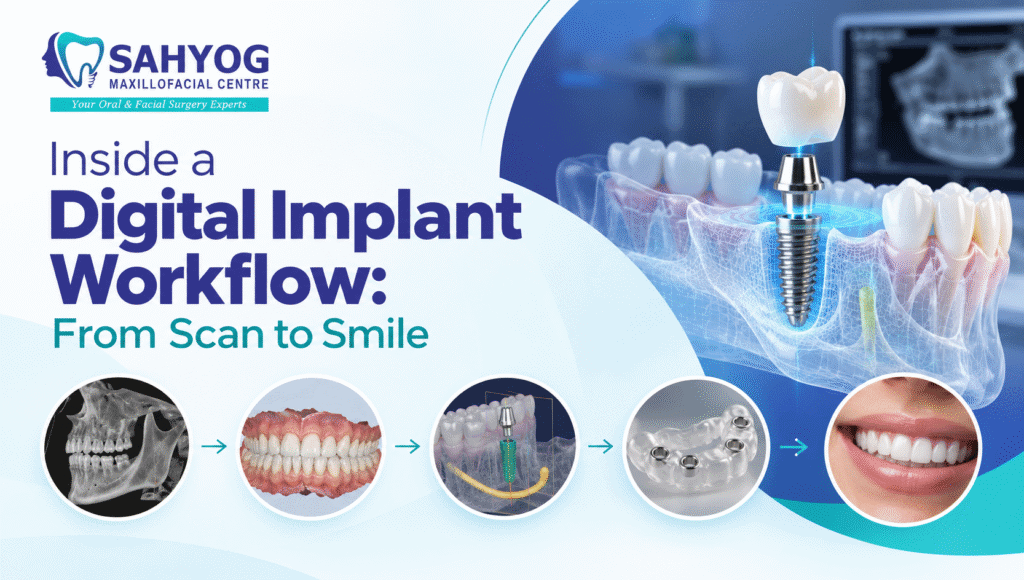
Dental implant treatment has come a long way from conventional X-rays, manual impressions and traditional surgical planning. Today, digital technology allows implant specialists to plan treatments with greater precision, better visualisation and a more personalised approach.
At Sahyog Maxillofacial Centre, technologies such as 3D CBCT scanning, intraoral scanning, digital implant planning, 3D-printed surgical guides, dynamic navigation and CAD/CAM work together to support a well-coordinated implant journey.
For patients considering dental implants in India, particularly NRIs and international patients, understanding this workflow can make treatment decisions easier and the overall experience more organised.
Step 1: Understanding Your Oral Health Through Digital Scans
Every implant treatment begins with a thorough evaluation of the patient’s oral health, jawbone structure and individual requirements.
A CBCT (Cone Beam Computed Tomography) scan provides a detailed three-dimensional view of the jaw, helping specialists examine bone availability and identify important structures such as nerves, sinuses and surrounding tooth roots.
Alongside this, an intraoral scanner creates a digital impression of the teeth and gums without relying on conventional impression materials.
Together, these technologies provide detailed information about the patient’s oral anatomy, forming the foundation for accurate diagnosis and implant planning.
This stage is especially important because no two patients have identical bone structures, dental conditions or restorative needs.
Step 2: Planning the Implant Before Surgery
Once the scans are completed, the information is transferred into specialised digital planning software.
The implant specialist can combine the CBCT scan with the intraoral scan to create a virtual representation of the patient’s mouth.This allows the clinician to evaluate the ideal implant position, depth and angle while considering the surrounding bone and anatomical structures.
More importantly, the final replacement tooth is considered during planning.
This approach, known as prosthetically driven implant planning, focuses on positioning the implant to support the eventual crown, bridge or full-mouth restoration.
For patients requiring multiple dental implants or full-mouth rehabilitation, digital planning helps coordinate the proposed implant positions as part of a comprehensive treatment strategy.
Step 3: Guided Implant Surgery With Digital Precision
Once the implant plan is finalised, digital technology helps transfer that plan into the surgical procedure.
One method involves 3D-printed surgical guides, which are customised according to the patient’s anatomy. These guides assist the surgeon in positioning surgical instruments according to the digitally planned implant placement.
Another advanced approach is dynamic navigation, which provides real-time guidance during implant surgery. Unlike a fixed surgical guide, dynamic navigation allows the surgeon to monitor the position and direction of instruments on a digital display throughout the procedure.
This can be particularly beneficial in complex cases where bone availability, anatomical structures or implant positioning require careful attention.
At Sahyog Maxillofacial Centre, the integration of digital planning and navigation technology supports a precise, carefully planned surgical approach.
Step 4: Designing the Final Smile With CAD/CAM
The digital workflow continues after the implant is placed.
Depending on the patient’s condition, the implant requires a healing period during which it integrates with the surrounding jawbone. The duration varies according to individual clinical requirements.
Once the implant is ready for restoration, digital impressions can be used to capture the details needed to design the replacement tooth. Through CAD/CAM (Computer-Aided Design and Computer-Aided Manufacturing) technology, the dental restoration can be digitally designed and manufactured.
This may include a single implant crown, an implant-supported bridge or a full-arch prosthesis. Digital restoration planning helps connect the surgical stage with the final prosthetic outcome, supporting a personalised fit, functional bite and natural-looking appearance.
The objective is not simply to replace a missing tooth but to restore comfortable chewing, aesthetics and overall oral function.
From Digital Precision to Confident Smiles
For NRIs and international patients seeking dental implants in India, digital implantology offers a more organised and personalised treatment experience. Advanced technologies such as 3D CBCT scans, virtual planning and dynamic navigation help specialists plan procedures with greater precision while supporting better coordination of treatment stages. However, successful outcomes depend equally on clinical expertise, accurate diagnosis and individual patient needs.
At Sahyog Maxillofacial Centre, advanced technology and experienced clinical judgement come together to ensure a carefully planned journey, from initial assessment to final restoration.
Planning dental implants in India? Connect with us to explore treatment options tailored to your needs.