
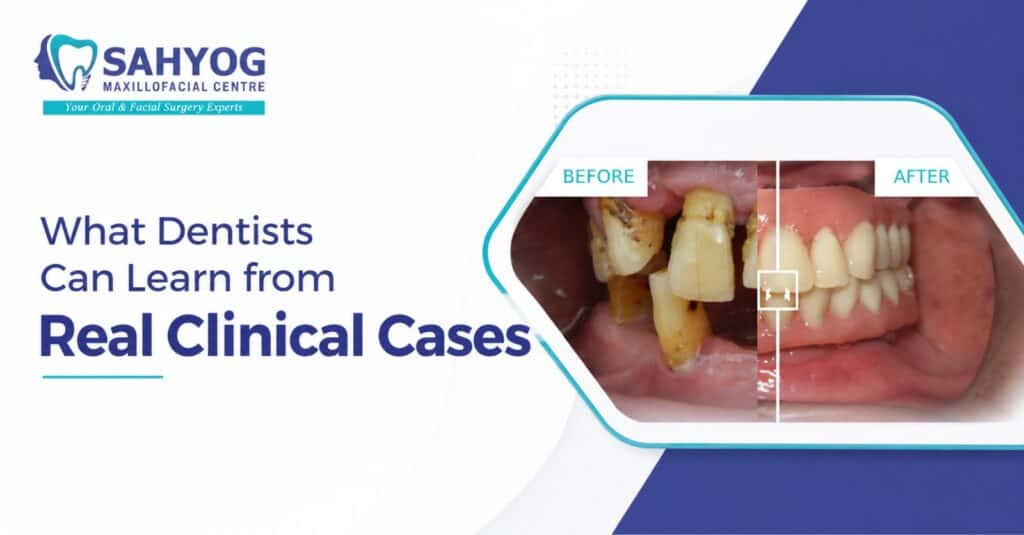
Dentistry gives us principles, protocols and techniques. Textbooks teach us what should happen. But real patients teach us what actually happens.
Every clinical case is different. Anatomy varies, expectations vary, and sometimes what looks simple on a radiograph becomes far more challenging once we begin treatment. A carefully planned procedure may need to change when we encounter something unexpected.
That is where clinical experience truly begins.
Real cases teach us to look beyond the obvious. A missing tooth is not simply a missing tooth. We need to consider bone, soft tissue, occlusion, aesthetics, function, patient expectations and long-term prognosis before deciding how to treat it.
They also teach us that knowing a technique is not the same as knowing when to use it. The ideal treatment described in a textbook may not always be the ideal treatment for the patient sitting in front of us.
Technology has transformed dentistry. CBCT, intraoral scanning, digital planning, guided surgery and dynamic navigation have made our diagnosis and treatment more precise. But technology can only support clinical judgment. A perfectly designed digital plan cannot compensate for an incorrect diagnosis.
And sometimes, our greatest lessons come from the cases that don’t go according to plan.
A guide may not fit. An unexpected anatomical finding may appear. A restoration may fracture. An implant may not behave exactly as planned. These situations force us to ask: What did we miss? Could we have anticipated it? What would we do differently next time?
A complication can therefore become a valuable learning experience.
Real cases also teach us the importance of knowing when to change direction. Sometimes the best clinical decision is to modify the plan, stage the treatment, involve another specialist, or even decide not to treat.
A successful treatment is not only about achieving a technically excellent result. It is also about understanding what the patient wants, explaining what is realistically possible and preparing them for the limitations, risks and maintenance involved.
Perhaps the most important lesson is that experience is not simply the number of years we have practiced. It is what we choose to learn from those years.
When we look back at a case and ask ourselves what went well, what could have been better and what we would do differently today, experience becomes learning.
That is why sharing real clinical cases is so valuable. Every clinician sees a case differently. One may focus on surgery, another on prosthetics, another on occlusion or aesthetics. The discussion itself expands our thinking.
Because dentistry is not about reproducing textbook cases.
It is about making the best possible decisions for real patients, with real challenges, in real situations.
The textbook gives us knowledge. The clinical case gives us the context.
Experience teaches us how to connect the two.
Every case has a lesson. Every challenge makes us better.
And every patient teaches us something new.