
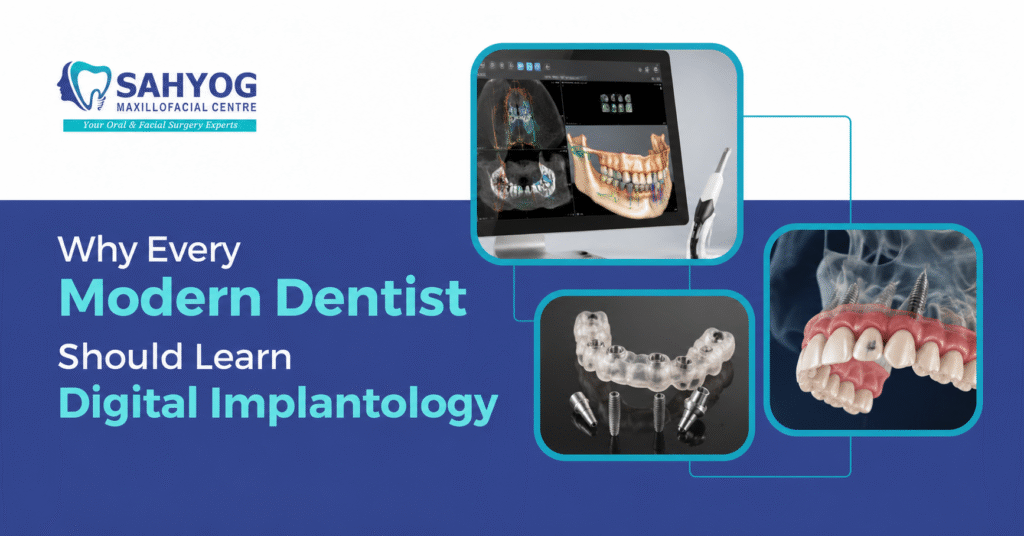
There was a time when placing dental implants depended almost entirely on a clinician’s surgical skill, experience, and a fair amount of educated judgment. Dentists studied radiographs, evaluated bone clinically, and planned treatment using two-dimensional information. While excellent outcomes were certainly possible, implant dentistry often involved a degree of uncertainty.
Today, that world has changed dramatically.
Imagine planning an implant procedure on a computer before the patient even sits in the dental chair! Imagine viewing the patient’s anatomy in three dimensions, assessing bone quality and quantity, identifying critical structures, and deciding the ideal implant position long before surgery begins! Now imagine having a navigation system that guides you during implant placement, showing the exact position of your drill in real time! Wait…Don’t IMAGINE it…. EXPERIENCE IT!
This is the world of digital implantology.
The rapid evolution of technology has transformed almost every profession, and dentistry is no exception. Patients book appointments online, expect digital communication, and actively seek clinics that offer advanced treatment options. When it comes to dental implants, they increasingly associate technology with precision, safety, and better outcomes. As a result, dentists who understand digital workflows are finding themselves better equipped to meet patient expectations and stay ahead in a competitive profession.
One of the most exciting aspects of digital implantology is the confidence it brings to treatment planning. Instead of relying solely on conventional methods, dentists can now combine CBCT scans, intraoral scans, and digital planning software to visualize the final result before the procedure begins. The implant is planned not just based on available bone, but also on the desired prosthetic outcome. This shift from simply placing an implant to planning a complete restoration represents a major advancement in modern dentistry.
For many dentists, implant placement can initially feel intimidating. Questions about angulation, proximity to vital structures, or achieving an ideal restorative position often create hesitation. Digital workflows help reduce these concerns by making treatment more predictable. Technologies such as guided surgery and dynamic navigation provide additional layers of accuracy and reassurance.
Among the innovations shaping modern implant dentistry, Navident has attracted considerable attention. Often compared to a GPS system for implant placement, Navident allows clinicians to track implant positioning in real time during surgery. Rather than relying solely on static guides, dentists can monitor and adjust their movements throughout the procedure. This level of precision can be particularly valuable in complex cases, limited bone situations, and full-arch rehabilitations.
The growing popularity of such technologies is also changing the way dentists learn implant dentistry. Traditional learning methods are increasingly being supplemented by comprehensive digital workflows. A modern digital implantology course no longer focuses only on surgical placement techniques. It introduces participants to digital diagnosis, treatment planning, navigation systems, guided surgery, prosthetic workflows, and integration of technology into daily practice.
This is important because the future implant dentist will need more than surgical skills alone. Understanding how to capture digital records, analyze CBCT data, plan prosthetically driven implant positions, and utilize digital tools effectively will become essential components of comprehensive patient care.
At the same time, patient demand for dental implants continues to grow. People are living longer, remaining active later in life, and increasingly seeking fixed solutions instead of removable dentures. Patients want treatment that is comfortable, efficient, and predictable. They want to know that their implant has been placed accurately and with the latest available technology. Dentists who can confidently provide these solutions are likely to see increasing opportunities in their practices.
Fortunately, gaining these skills has become more accessible than ever. The quality of implant training available in India today has improved tremendously. Several advanced implant courses in India now provide exposure to digital workflows that were once available only in select international centers. Dentists can learn from experienced clinicians, observe live surgeries, participate in hands-on sessions, and understand how digital technologies are applied in real clinical situations.
Perhaps the most compelling reason to learn digital implantology is that it represents the direction in which the profession is moving. Digital impressions are replacing conventional impressions. Virtual treatment planning is becoming routine. Guided surgery and dynamic navigation are becoming increasingly common. Artificial intelligence is beginning to influence diagnostics and treatment planning. The dentists who embrace these changes today will be better prepared for the demands of tomorrow.
Learning digital implantology is not about replacing clinical judgment. It is about enhancing it. Technology does not eliminate the need for experience and expertise; instead, it amplifies a clinician’s ability to make informed decisions and deliver predictable results. The goal is not to let technology do the work, but to use technology to perform dentistry more accurately, efficiently, and confidently.
The question is no longer whether digital workflows will become mainstream in implant dentistry. That transition is already underway. The real question for today’s dentist is whether they want to lead this transformation or simply try to catch up later.
For clinicians looking to expand their skills, improve treatment outcomes, and future-proof their practices, investing in a digital implantology course may be one of the most valuable professional decisions they can make. As implant dentistry continues to evolve, those who embrace advanced implant training, understand technologies such as Navident, and adopt modern digital workflows will be best positioned to deliver exceptional care and thrive in the future of dental implants.